Noise & Decoherence – Why Quantum is Fragile
To understand why building a quantum computer is one of the greatest engineering challenges in human history, we have to look at what makes quantum computing so powerful in the first place: superposition and entanglement.
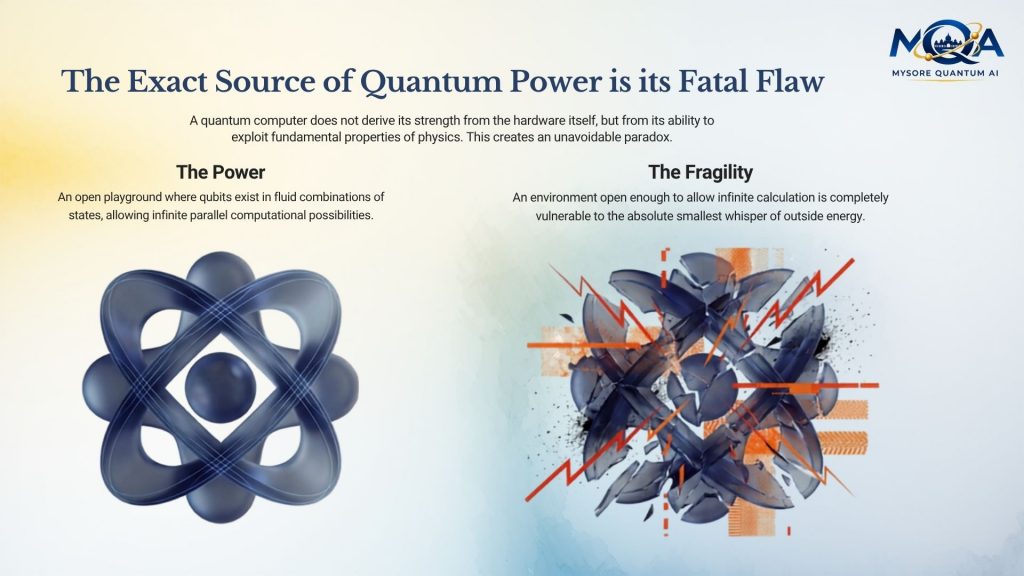
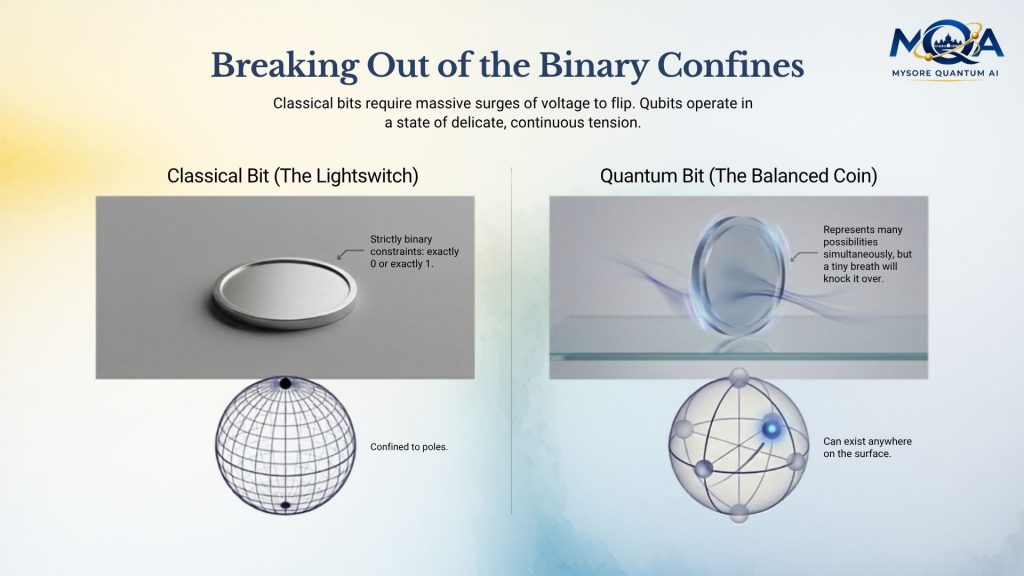
While a classical bit is like a light switch, either strictly 0(off) or 1(on). A quantum bit (qubit) can exist in a fluid combination of both states simultaneously. We often visualize this using a mathematical tool called the Bloch sphere, where a classical bit is confined to the north and south poles, but a qubit can live anywhere on the surface of the globe.
The catch? This open playground makes qubits incredibly sensitive. While a classical bit requires a relatively massive surge of voltage to accidentally flip from a 0 to a 1, a qubit can be knocked off balance by the absolute smallest whisper of energy from the outside world. This susceptibility is what we call quantum fragility, and its main drivers are noise and decoherence.
1. Quantum Information: Powerful but Delicate
Quantum computation derives its strength from unique quantum properties rather than from the qubit itself. These properties include:
- Superposition, which allowing multiple computational possibilities to exist simultaneously
- Entanglement, which creates correlations between qubits that classical systems cannot reproduce
- Quantum interference, which amplifies useful outcomes while suppressing undesirable ones
The challenge is that these properties depend on maintaining a precise quantum state throughout the computation.
As seen earlier, quantum state can be represented as:

For a computation to succeed:
- The amplitudes must evolve accurately
- Relative phases between states must remain preserved
- Entanglement among qubits must remain intact
2. What is Quantum Noise?
In the classical world, noise might mean static on a radio station. In the quantum world, noise refers to any unwanted interaction between a qubit and its surrounding environment that alter the state of a qubit during computation.
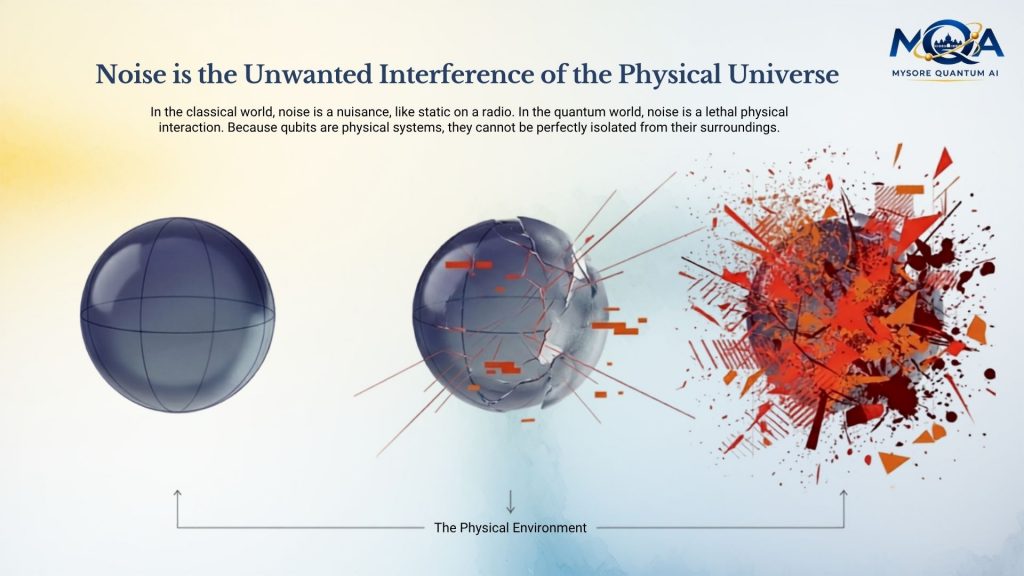
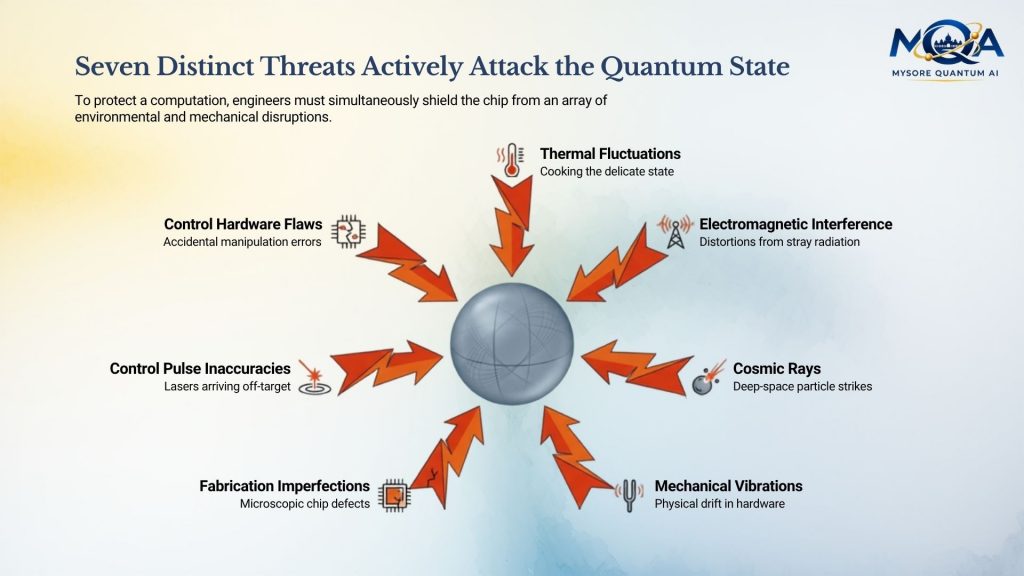
Because qubits are physical systems whether they are superconducting circuits, trapped ions, or photons, they cannot be perfectly isolated. Environmental interference comes in many forms:
- Thermal Fluctuations: Tiny amounts of heat can cook the delicate quantum states. This is why many quantum computers must be cooled to near absolute zero (around 0.01K), making them colder than deep space.
- Electromagnetic Interference: Stray Wi-Fi signals, cell phone radiation, or even the Earth’s magnetic field can distort a qubit’s state.
- Control Hardware Imperfections: The very lasers or microwave pulses used by engineers to manipulate qubits can introduce tiny, accidental errors.
- Cosmic Rays and Background Radiation: High-energy particles from deep space, as well as trace radiation from concrete or surrounding materials, can strike a quantum chip. This creates a burst of quasi-particles (broken electron pairs in superconductors) that can cause widespread, simultaneous errors across multiple qubits.
- Mechanical Vibrations: Microscopic tremors from nearby equipment, cooling pumps, or even sound waves can cause physical shifts in the hardware. In systems like trapped ions or neutral atoms, these vibrations cause the qubits to physically drift out of the path of the lasers trying to control them.
- Imperfections in Hardware Fabrication: No manufacturing process is flawless. Microscopic defects on a quantum chip, impurities in materials, or tiny variations in the size of a superconducting junction mean that no two qubits are perfectly identical. These structural flaws introduce permanent, unpredictable biases.
- Control Pulse Inaccuracies: To execute quantum gates, engineers blast qubits with incredibly precise micro-bursts of lasers or microwave pulses. If a pulse is even slightly too long, too short, too intense, or arrives a fraction of a nanosecond off-target, it introduces systematic execution errors.
3. Everyday Analogy: Balancing a Coin
Imagine balancing a coin vertically on a table. A classical bit is like a coin lying flat: 1 for Heads and 0 for Tails. A qubit is like the coin balanced perfectly on its edge. While balanced, It represents many possibilities simultaneously. But even a tiny disturbance can make it fall.
4. The Ultimate Enemy: Decoherence
If noise is the individual disturbance, decoherence is the process by which the quantum magic actively leaks out of the system.
When a qubit interacts with its environment, it becomes entangled with the billions of atoms surrounding it. The environment effectively measures the qubit, forcing its rich, fluid superposition to collapse into a mundane, classical state of either 0 or 1.
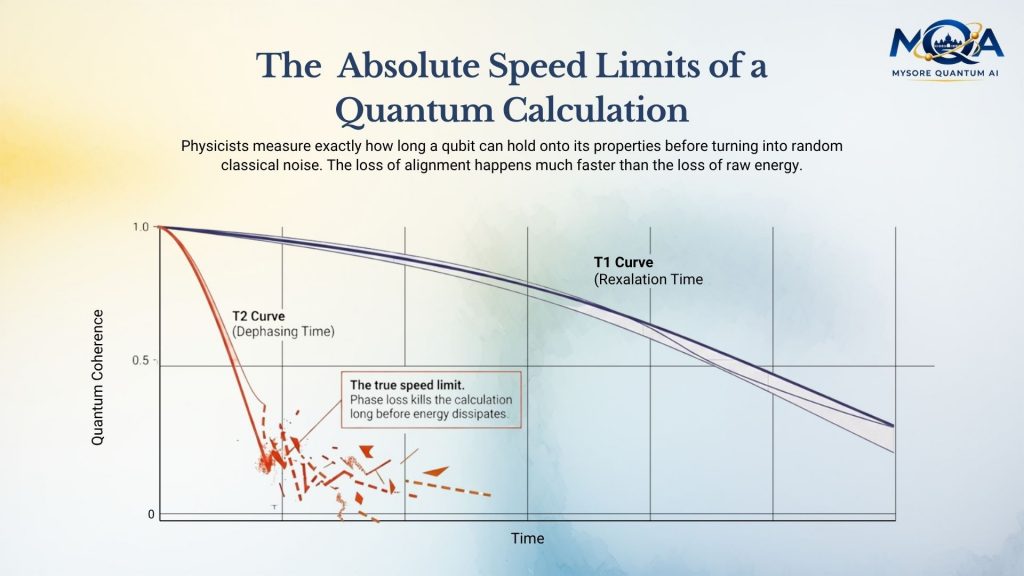
Physicists measure how long a qubit can hold onto its quantum properties using two core metrics:
- T_1 (Relaxation Time): The time it takes for a qubit in the excited |1⟩ state to lose its energy and drop back down to the ground |0⟩state.
- T_2 (Dephasing Time): The time it takes for a qubit to lose its phase relationship (its superposition alignment). T_2 is typically shorter than T_1 and represents the true speed limit for how long a quantum calculation can run before turning into random classical noise.
5. Why Phase Matters
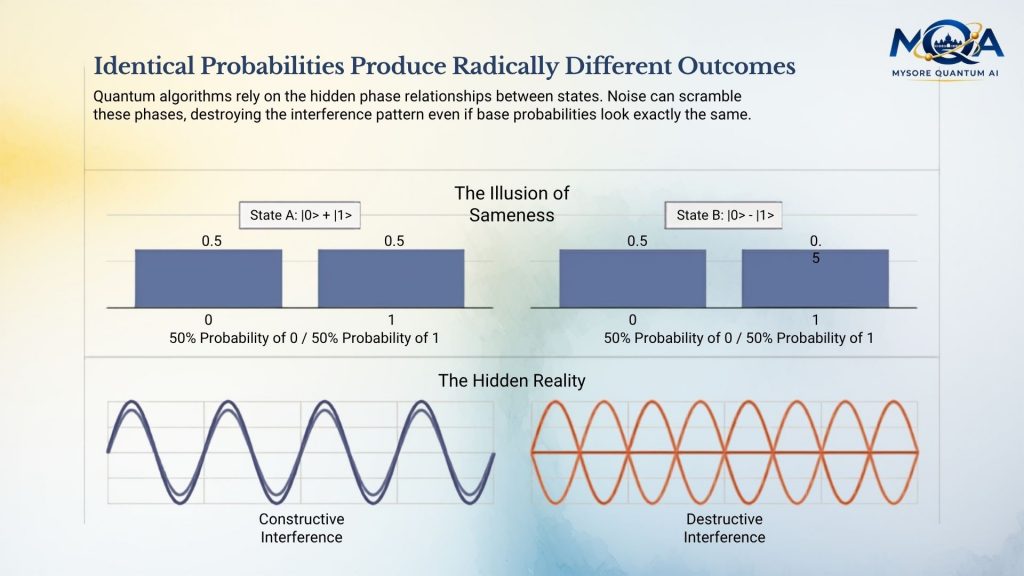
Quantum algorithms depend not only on probabilities but also on phase relationships between states. Two states with identical probabilities can behave completely differently if their phases differ.
For example:
State A:
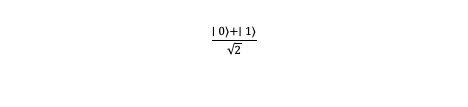
State B:

Both states produce:
- 50% probability of measuring 0
- 50% probability of measuring 1
But they interfere differently during computation. Noise can disturb these phases and destroy the intended interference pattern.
6. Main Types of Quantum Errors
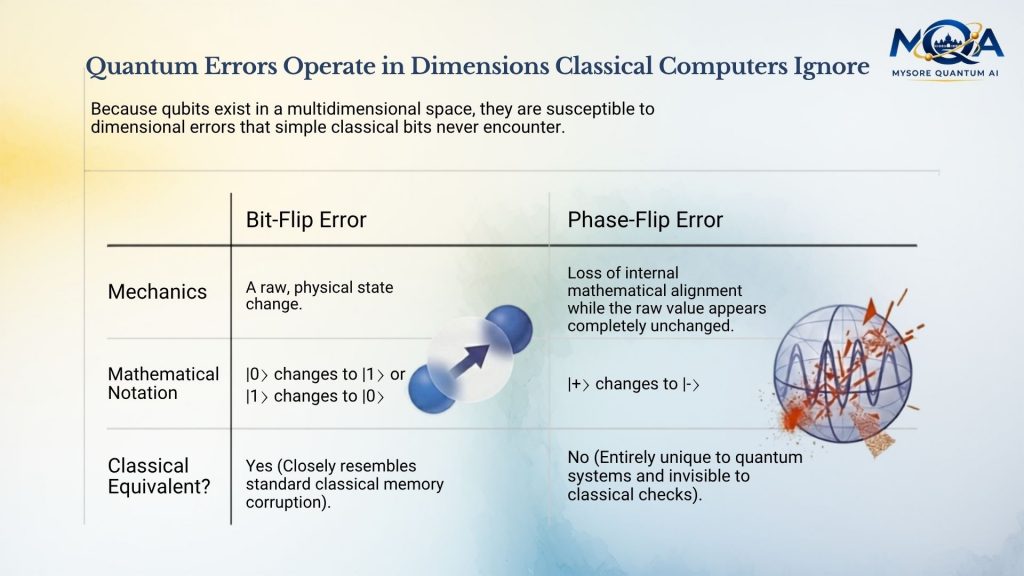
A) Bit-flip error
A qubit unexpectedly changes state:

or

This resembles a classical error.
B) Phase-flip error
The value appears unchanged, but phase changes:

This type of error has no classical equivalent.
7. Why Noise Becomes Worse with More Qubits
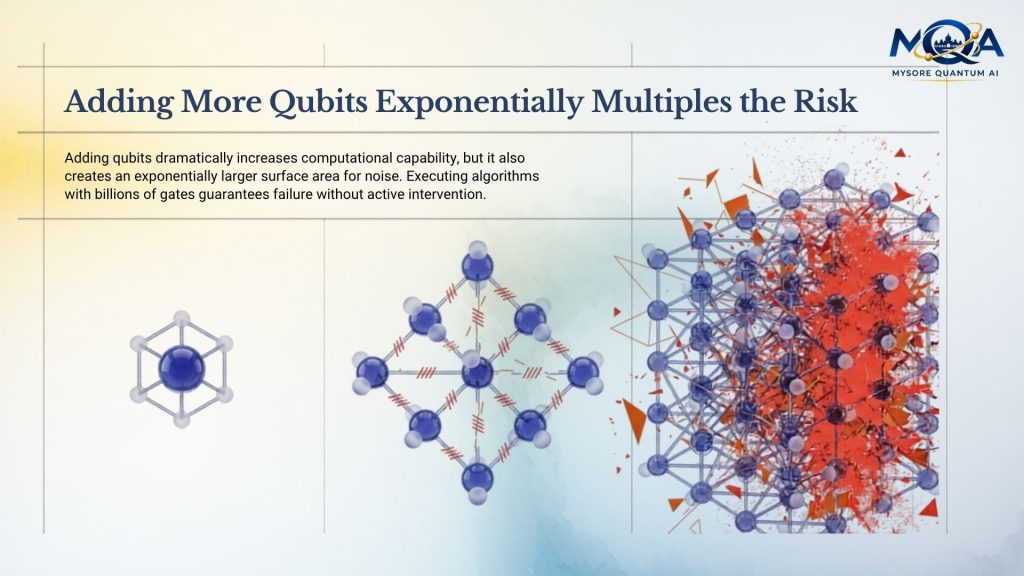
Adding qubits increases computational capability but also increases complexity.
More qubits mean:
- More interactions
- More control signals
- More possible error sources
- Greater cumulative error
For example: If one gate has 99.9% accuracy, Then after many operations, errors accumulate. Large algorithms may involve millions or billions of gates. Even tiny errors become significant.
8. The Road to Resilience: Fault Tolerance
Because we cannot perfectly isolate a quantum system, running a useful quantum algorithm requires fighting back against noise. This is where Quantum Error Correction (QEC) comes into play. In classical computing, the data can be protected by simply making copies (e.g., storing a bit as 000 instead of 0). If one bit flips to a 1, a majority vote wins. In quantum mechanics, the No-Cloning Theorem proves that it is physically impossible to make an exact copy of an unknown quantum state.
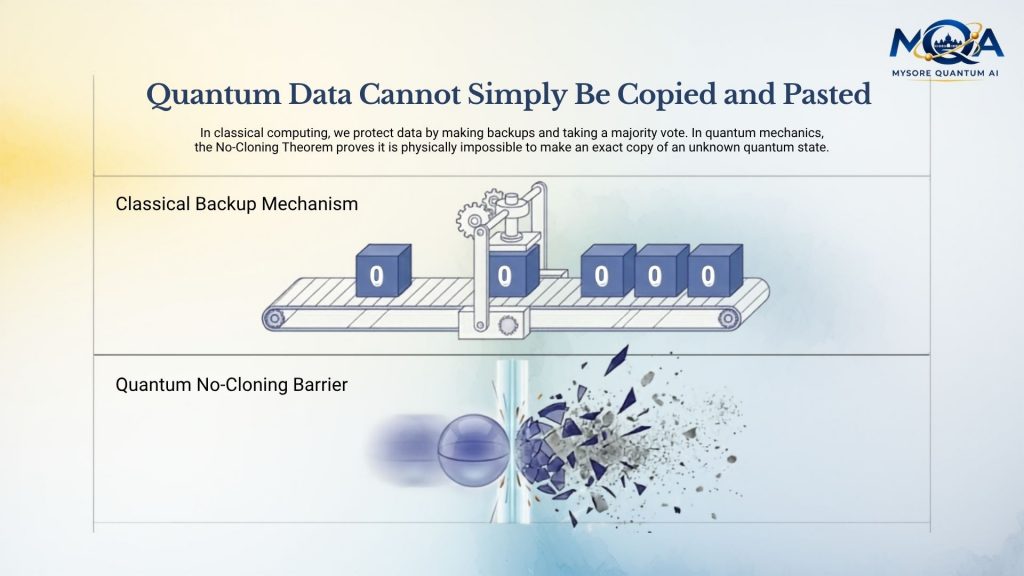
To bypass this restriction, scientists use highly sophisticated topologies like the Surface Code to entangle multiple fragile, physical qubits together into a single, highly protected logical qubit.
The Scale of the Challenge: Today’s physical qubits might have an error rate of around 10-3(1 error in 1,000 operations). For complex algorithms that can break encryption or simulate new molecules, we need error rates closer to 10-15. Bridging this gap requires thousands of physical qubits working together just to maintain a single error-free logical qubit.
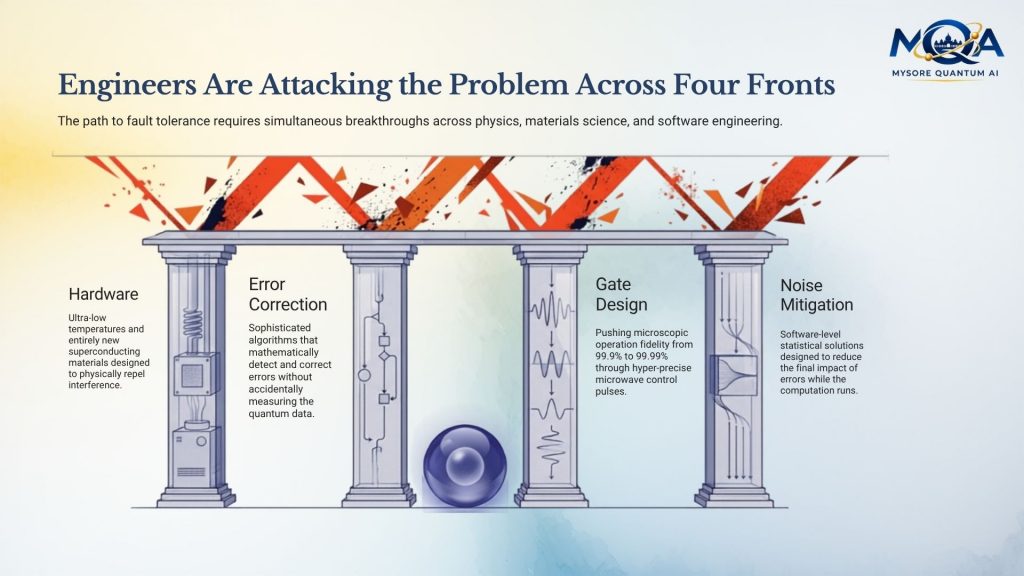
9. How Researchers Fight Noise
Current approaches include:
Better hardware
- Ultra-low temperatures
- Improved materials
- Reduced electromagnetic interference
Error correction
Detect and correct errors without destroying quantum information.
Better gate design Increase gate fidelity:

Noise mitigation
Reduce error impact during computation.
10. Why This Matters
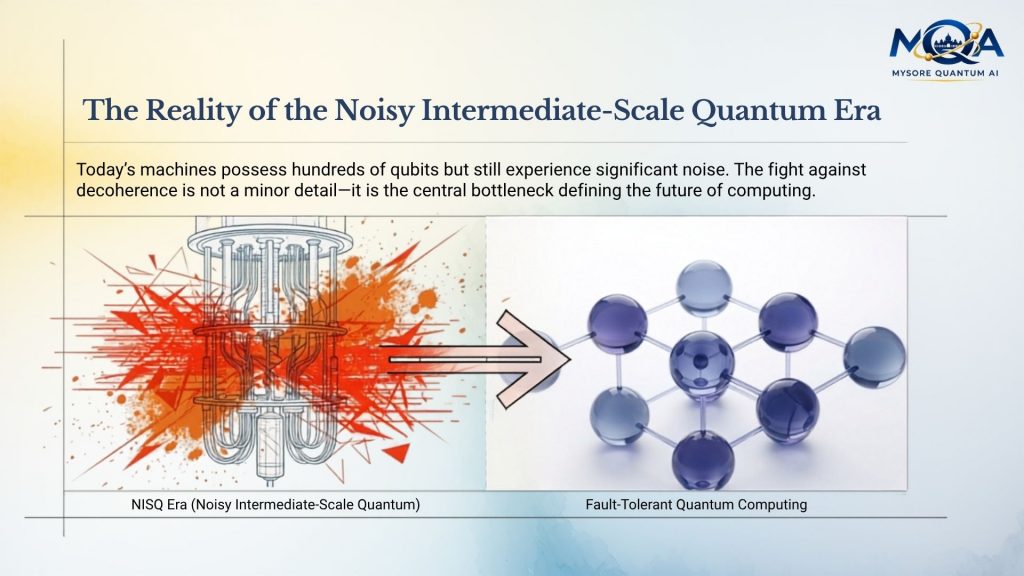
Quantum computing today is often called the Noisy Intermediate-Scale Quantum (NISQ) era.
Noisy Intermediate-Scale Quantum
Current machines:
- Have tens to thousands of qubits
- Still experience significant noise
- Cannot yet perform fully fault-tolerant large computations
Noise and decoherence are therefore not minor engineering details, they are among the central reasons why building large-scale quantum computers remains difficult.