Quantum Computing – What is it?
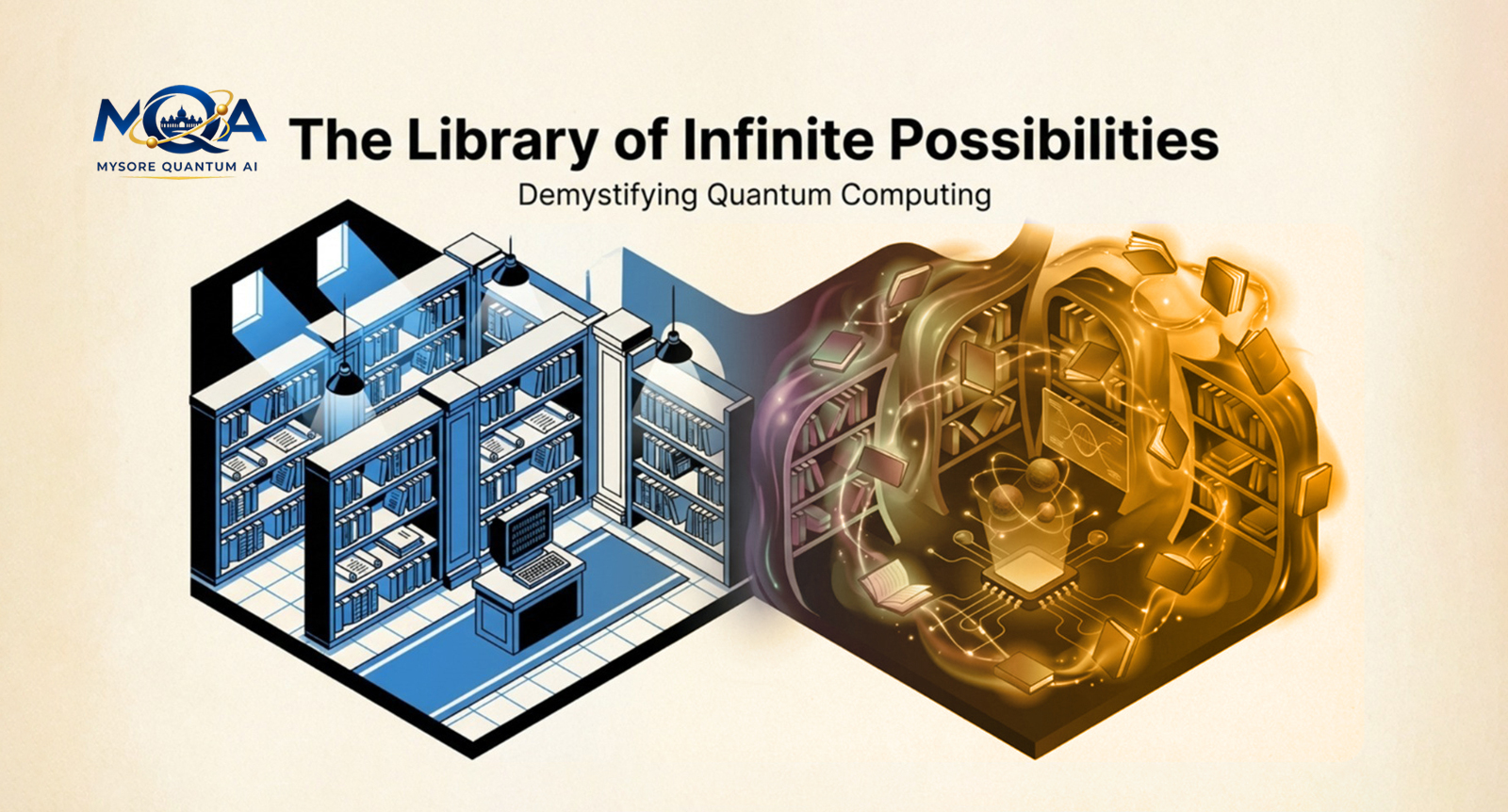
Quantum Computing: The Library of Infinite Possibilities
Imagine you are standing in a massive, ancient library looking for a specific sentence hidden in one of the millions of books.
The Traditional Approach: The Speed-Reader
A classical computer (the phone in your pocket or the laptop on your desk) works like an incredibly fast speed – reader. To find that sentence, it picks up Book A, flips through the pages, puts it down, and moves to Book B.
Even though it’s fast, it is still doing one thing at a time. This is because classical computers use bits – tiny switches that are either 0 (Off) or 1 (On).

The Quantum Approach: The Multiverse Reader
A quantum computer doesn’t just read faster; it changes the rules of the search entirely. Instead of one reader, imagine a “ Multiverse Reader” who can exist in a state of Superposition.
Instead of checking books one by one, the Multiverse Reader can float through every aisle simultaneously. They don’t look at Book A then Book B; they interact with the entire library at once. This is the power of the Qubit.

The Three Pillars of Quantum Magic
- Superposition (The “Both/And” State): While a bit is a coin lying on a table (either Heads or Tails), a qubit is a spinning coin on the table. While it’s spinning, it is effectively both Heads and Tails at the same time. Only when you stop the coin (measure it) does it “decide” to be a 0 or a 1.

- Entanglement (The “Telepathic” Connection): This is what Einstein called “spooky action at a distance.” You can link two qubits so that they share a single existence. This allows quantum computers to explore many possibilities at once. Eg: If you have two “entangled” spinning coins and you stop one to find it’s “Heads,” the other coin will instantly stop on “Heads” (or “Tails,” depending on the setup), even if it’s on the other side of the universe.
- Interference (The “Search Filter”): This is how we get the answer. While moving through the library, the Multiverse Reader leaves behind echoes of possibilities for every sentence that might be the answer.
Think of every path through the library producing a whispering echo:
Wrong sentences produce echoes that cancel each other out.
The correct sentence produces echoes that reinforce each other.
It works like sound waves:
When two waves meet out of sync, they cancel (silence).
When two waves meet in sync, they amplify (louder sound).
How It Looks in the Library
Imagine the reader moves through thousands of possible book paths:
| Path | Sentence Found | Echo Effect |
| Page in Book A | Wrong sentence | Cancels |
| Page in Book F | Wrong sentence | Cancels |
| Page in Book X | Correct sentence | Amplifies |
| Page in Book T | Wrong sentence | Cancels |
Quantum operations are designed so that:
Wrong answers interfere destructively → their echoes fade away.
Correct answers interfere constructively → their echoes grow stronger.
By the time the reader finishes:
The entire library becomes almost silent except for one loud whisper.
That whisper is the correct sentence from a book.


Why Does This Matter?
Quantum computers aren’t just “faster laptops.” In fact, for watching Netflix or writing an email, they might actually be slower. Their true power lies in complexity.
They excel at problems where the number of possibilities is astronomical – like simulating how a new medicine molecules will react in the human body, or optimizing the world’s global shipping routes to save massive amounts of fuel. They don’t just find the needle in the haystack; they make the haystack transparent.
Bottom Line: Classical computing is about certainty (Yes or No). Quantum computing is about probability and the ability to explore a million paths at the exact same moment.