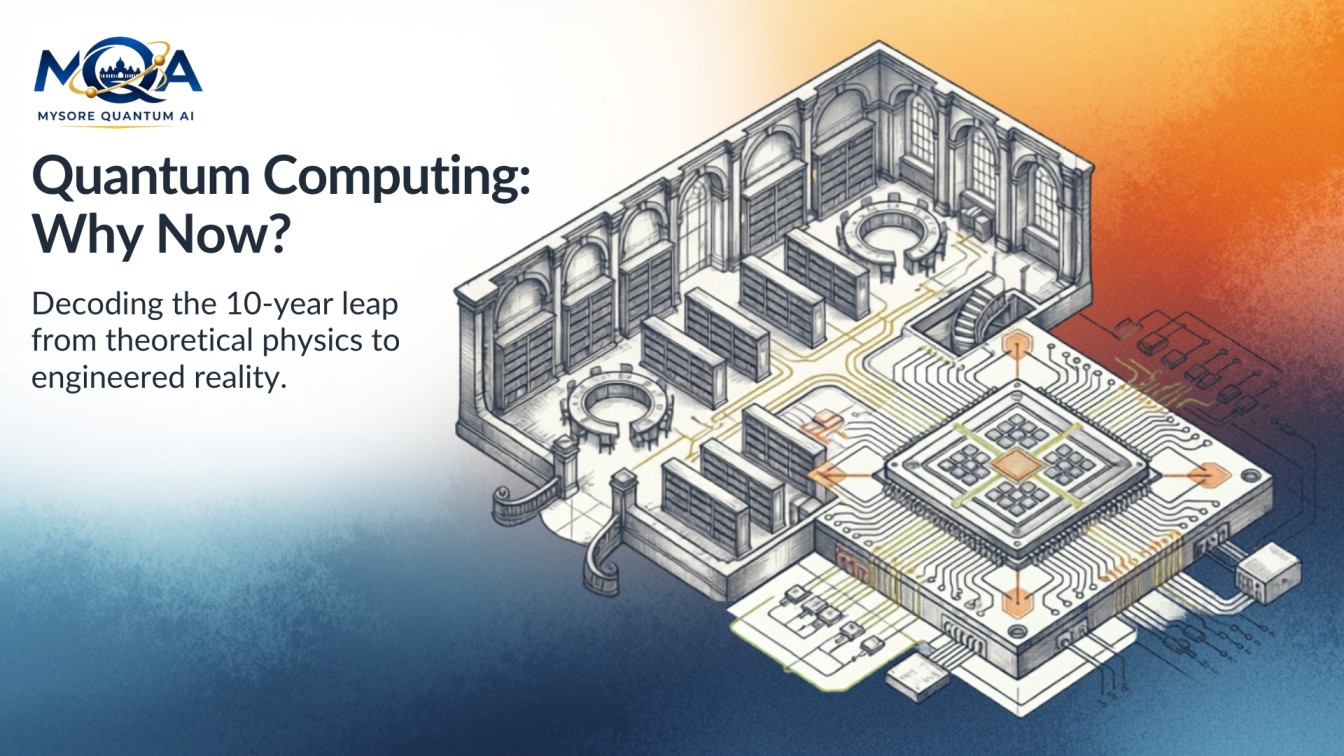
Quantum Computing: Why Now? What Changed in the Last 10 Years?

For decades, scientists understood the idea of the Multiverse Reader (quantum computing), but they couldn’t actually build one.

So the question is:

Why has quantum computing suddenly become such a big deal in the last decade?

Let’s return to the library.

The Library Awakens

For years, scientists had the theory of the Multiverse Reader, but three huge obstacles stopped them:

  1. The reader kept disappearing when observed.
  2. The library was too noisy.
  3. Nobody knew how to scale the search across thousands of books.

Over the last 10 years, three major breakthroughs started solving these problems.

1. We Finally Learned How to Build Stable “Readers” – Better Qubits

Earlier attempts to build quantum computers were like hiring readers who lost their memory after a few seconds.

Quantum bits (qubits) are extremely fragile. Even tiny disturbances—heat, vibration, electromagnetic noise – can destroy their quantum state. This problem is called decoherence.

In the last decade:

  • Researchers learned how to isolate qubits better
  • Cooling systems reached near absolute zero
  • Materials and fabrication improved dramatically

Companies like IBM, Google, and IonQ began building processors with tens to hundreds of qubits, instead of just a few unstable ones.

In our library story:

Before:
The Multiverse Reader vanished after opening two books.

Now:
The reader can stay in the library long enough to explore entire aisles.

2. We Learned How to Reduce the Library’s Noise – Quantum Error Correction

Even if the Multiverse Reader exists, the library is extremely chaotic.

Footsteps echo. Pages rustle. Random whispers distort the search.

This represents quantum noise.

In the past decade, scientists developed practical methods for quantum error correction – ways to detect and fix mistakes without collapsing the quantum state.

Instead of one fragile reader, we now use teams of readers that watch each other and correct mistakes.

Think of it like:

Several assistants quietly confirming the same sentence without disturbing the reader.

Major research from institutions like MIT and Caltech helped turn error correction from theory into real experiments.

3. We Learned How to Organize the Search – Quantum Algorithms & Software

For a long time, we had the library and the reader – but no clear instructions on how to perform useful searches.

Over the last decade:

Researchers built powerful quantum algorithms, improved development tools, and created programming frameworks.

Platforms such as:

  • Qiskit from IBM
  • Cirq from Google

allow developers to experiment with quantum programs on real machines.

In the library analogy:

Before:
The reader wandered randomly through books.

Now:
We give the reader precise instructions on how to move through the library so the right echoes amplify.

4. The World’s Biggest Tech Companies Joined the Race

Quantum research used to live mostly in universities.

In the last decade, massive investment arrived from companies like:

  • IBM
  • Google
  • Microsoft
  • Amazon
  • Intel

This brought:

  • billions of dollars in funding
  • large engineering teams
  • cloud access to quantum machines

Now anyone can experiment with quantum computers through services like Amazon Braket.

In our library story:

The lonely researcher searching the library has been replaced by thousands of engineers building better tools and maps.

5. A Milestone Moment: Quantum Supremacy

In 2024, researchers at Google announced a milestone in quantum error correction using their Willow quantum processor..

They demonstrated a calculation that would take a classical supercomputer thousands of years but took the quantum machine minutes.

While the task itself wasn’t practically useful, it proved something critical:

The Multiverse Reader actually works.

So Why Quantum Now?

Because three things finally happened at the same time:

ThenNow
Fragile qubitsMore stable quantum hardware
Too much noiseEmerging error correction
No practical ecosystemReal software tools and cloud access