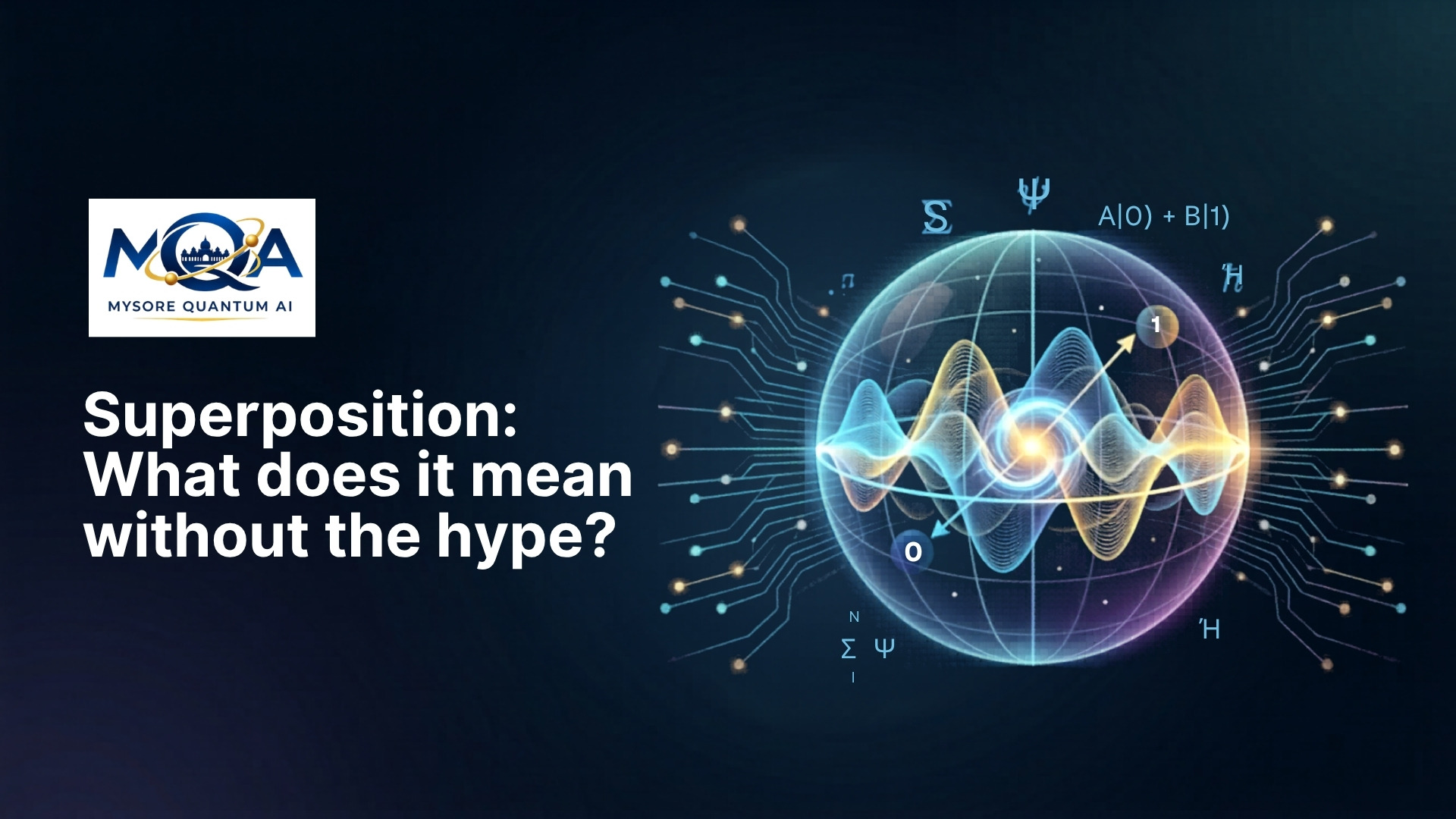
Superposition – what does it mean without the hype

The Core Idea

Recalling superposition from previous article, a qubit described as a combination of two states, written mathematically as:

|ψ⟩ = α|0⟩ + β|1⟩

Here:

  • |0⟩ and |1⟩ are the standard basis states (like classical 0 and 1)
  • α and β are complex numbers called probability amplitudes
  • The rule: |α|² + |β|² = 1

To be precise, this does not mean the qubit “is both 0 and 1 in a classical sense.”
It means the system is in a state that will yield 0 or 1 with certain probabilities when measured.

What Superposition Actually Gives You

Superposition allows a quantum system to encode multiple possibilities in its state description, but:

  • You only get one outcome per measurement
  • The advantage comes from how amplitudes evolve before measurement, not from “reading all answers at once”

So the real power is not in storing many answers, but in:

manipulating probability amplitudes so the right answer becomes more likely

A More Accurate Intuition

Instead of “being in two states at once,” think:

A qubit is like a vector pointing somewhere on a sphere (called the Bloch sphere)

  • |0⟩ which is north pole
  • |1⟩ which is south pole
  • Superposition is any point in between

The exact position determines:

  • Probability of measuring 0
  • Probability of measuring 1

Where do people get it wrong

Let’s correct common misconceptions:

 Myth 1: “Quantum computers try all possibilities simultaneously and read them all.”
Reality: They evolve a probability distribution and extract one result.

Myth 2: “Superposition alone gives exponential speedup.”
Reality: Without interference and algorithm design, superposition is useless.

Myth 3: “It’s just parallel computing.”
Reality: Classical parallelism ≠ quantum superposition.
Quantum states combine coherently, meaning amplitudes can interfere.

Simple Example (1 Qubit)

Start with |0⟩ and apply a Hadamard operation which puts it into:

|+⟩ = 1/√2 (|0⟩ + |1⟩)


Bloch Sphere
Now: Probability(0) = 50% Probability(1) = 50% If you measure, you get either 0 or 1 randomly.  

So what changed?

Not the output, but the state before measurement, which can now interact with other qubits and operations.

Why It Matters in Computation

Superposition becomes powerful when combined with:

  • Interference, which amplifies correct answers
  • Entanglement, which correlates multiple qubits

Example:

  • With n qubits, you represent 2ⁿ amplitudes
  • A 50-qubit system, over 1 quadrillion amplitudes

But again:

You don’t read all 2ⁿ values but you shape them.

The Practical Limitation

Superposition is fragile:

  • Measurement collapses it
  • Noise destroys it (decoherence)
  • Maintaining it requires extreme conditions (near absolute zero, isolation)

That’s why building quantum computers is hard.

Bottom Line

Superposition is:

A mathematical state that encodes probabilities, enabling interference driven computation before measurement collapses the result.